
Why Most Small Businesses in Minnesota Don't Have a Real Lead Generation System (And How to Build One)

Updated: Aug 23

There's a pattern I've seen play out repeatedly across businesses in the Twin Cities, Stillwater, Hudson, and the surrounding area. Business slows down. The owner runs some Facebook ads or posts more on social media. Things pick up a little. They get busy, the marketing stops. Business slows again.
That cycle isn't a strategy. It's marketing as a reaction to fear — a burst of activity when things get quiet, followed by neglect when things feel okay again. The result is a business that never quite knows where the next client is coming from.
What these businesses are missing isn't more marketing. It's a lead generation system for Minnesota small businesses that runs on its own — whether they're actively working on it or not.
Activities vs. Systems: What a Real Lead Generation System for Minnesota Small Businesses Looks Like
A marketing activity is something you do. A marketing system is something that runs.
Posting on social media today is an activity. Having a content calendar, a posting schedule, a response protocol, and a process for turning engaged followers into leads is a system.
Running a Google ad this month is an activity. Having a Google Ads campaign integrated with a landing page, a follow-up email sequence, and tracking that tells you your cost per lead is a system.
Systems produce predictable results. Activities produce unpredictable ones.
A business with a real marketing system doesn't need to panic when things slow down. The system is always running. They can see what's working and what isn't. They don't start from scratch every time they want to generate leads. A structured digital marketing approach is what separates a business running activities from one running an actual system.

The 4-Stage Lead Generation System That Works for Twin Cities
Small Businesses
Here's the framework we use at Trio Assist when we build lead generation systems for businesses in Minnesota and Wisconsin.
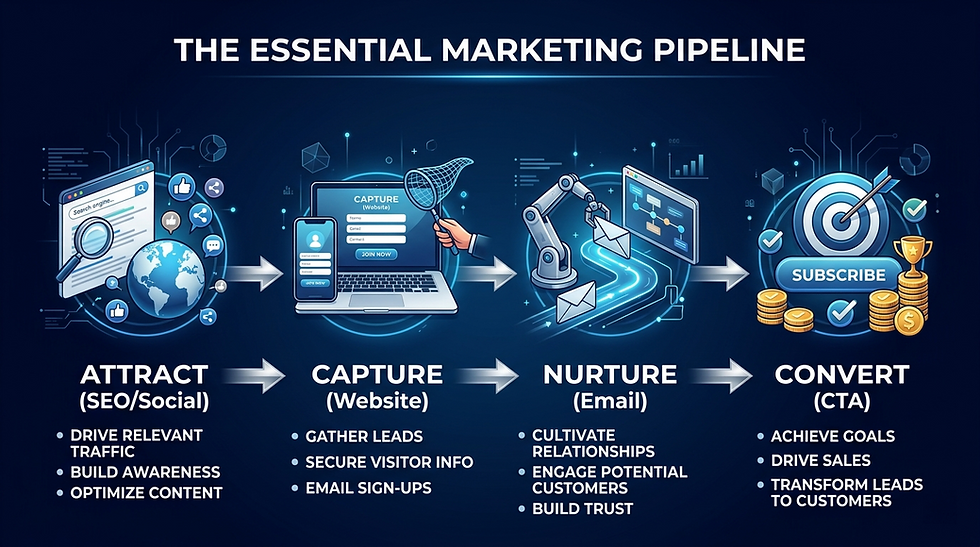
Stage 1: Attract
This is how potential customers find out your business exists. For most Twin Cities small businesses, that means appearing in local Google search results through local SEO and Google Business Profile, showing up on social media platforms where your audience spends time, running targeted paid ads to reach people actively looking for what you do, and publishing content that answers the questions your customers are asking before they know they need you.
Most businesses do one or two of these sporadically. A real system does all of them, coordinated so they reinforce each other.
Stage 2: Capture
Getting someone to your website is only the first step. The capture stage is about giving that visitor a reason to take action — and making it easy to do so. This is where most businesses leak leads. Someone finds them through Google, lands on the website, doesn't see a clear next step, and leaves.
A site that drives traffic but fails to act on it has the same conversion structure problem this stage is built to solve.
Capture requires a web design built with conversion architecture: a prominent call to action, a simple contact form, and trust signals that give the visitor confidence to reach out.
Stage 3: Nurture
Not everyone who engages with your marketing is ready to hire you today. Nurture keeps your business in front of interested prospects over time until they're ready. For most small businesses, nurture happens primarily through email marketing — a welcome sequence for new contacts followed by regular, useful communication that keeps the relationship warm.
Stage 4: Convert
This is the close — the moment a prospect becomes a customer. It requires a clear offer, a specific call to action, and a frictionless path to taking that action. Every stage before this exists to bring the right people to this moment with enough trust to act.
What We See Most Often With Twin Cities Businesses
Most small businesses we work with have some version of all four stages — they're just not connected. Their SEO and social media are attracting some traffic. Their website is capturing some leads. They might be sending the occasional email. They close the leads they get.
This is the exact gap automation closes — without it, leads sit in a spreadsheet the same way they do before any system is installed.
But nothing flows smoothly from one stage to the next. Prospects fall out at every gap. Leads go into a spreadsheet and never get followed up on. The email list sits unused for months.
Connecting these stages — so that traffic flows through a structured system toward conversion — is what turns inconsistent, reactive marketing into something that generates leads whether you're actively working on it that day or not.

Ready to Build Something That Actually Works?
If your lead flow has felt unpredictable, the starting point is an honest look at where your current system is leaking. We offer a free consultation to walk through that together.
📍 Trio Assist, LLC | Lake Elmo, MN | info@trioassist.com | trioassist.com/contact
Frequently Asked Questions
What is a lead generation system for a small business?
A structured, repeatable set of marketing activities that consistently attracts, engages, and converts potential customers — designed to produce predictable results rather than reactive bursts.
Why do most small businesses in Minnesota struggle with consistent lead generation?Because they do marketing activities rather than run a system. Activities are disconnected. A system connects every touchpoint into a coherent funnel with predictable outcomes.
How long does it take to build a lead generation system?
Foundation: 4 to 8 weeks. Full system with nurture: 3 to 6 months. Results compound over time.
What should be the first step?
Fix the conversion foundation — website and Google Business Profile — before investing in more traffic.
How do I know if I have a system or just activities?
If you can't trace specific leads back to specific marketing efforts, you have activities. A system is measurable at every stage.
Can Trio Assist build this for my Twin Cities business?
Yes. We offer a free consultation to start that conversation.
Ready to Grow Your Business?
Trio Assist helps Minnesota and Wisconsin businesses turn clicks into customers. Schedule a Free Consult or get your Free Website Audit — no cost, no obligation. Reach us at info@trioassist.com or 651-705-6391.
About the Author

Brandon G. Wallin Owner & Founder, Trio Assist
Brandon G. Wallin is the Owner and Founder of Trio Assist, a marketing agency based in Minnesota serving Stillwater, the St. Croix Valley, the Twin Cities, and businesses across the United States. He helps service-based companies build structured, high-performing marketing systems rooted in technical SEO, authority building, and long-term strategy.
Brandon believes growth isn't about chasing algorithms — it's about installing the right foundation. His work focuses on helping businesses rank where it matters, convert more consistently, and scale with clarity instead of guesswork.
When he's not building digital ecosystems, Brandon stays closely connected to the local business community throughout Minnesota and Western Wisconsin.


