
Why Local Businesses Struggle to Rank on Google (And How to Fix It)

Updated: Sep 8
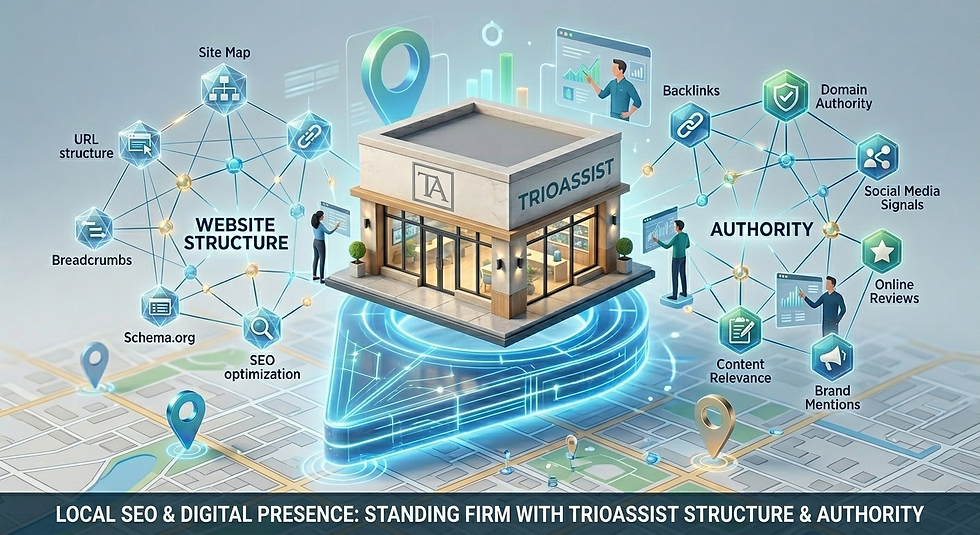
If you own a local business and feel invisible on Google, you’re not alone.
You might be:
Posting on social media
Boosting posts occasionally
Running some ads
Updating your website
Asking for reviews
Yet when you search your service + your city… You’re nowhere. Why? Because most local businesses are missing structural alignment.
If you're unsure whether your local SEO foundation is installed correctly, you can always get an expert assessment.
Quick Answer: Why Don’t Local Businesses Rank?
Local businesses struggle to rank because:
Their Google Business Profile isn’t fully optimized
Their website lacks geographic clarity
Service pages are too broad
Internal linking is weak
Authority signals are minimal
Technical SEO is ignored
Ranking locally requires alignment between Google Maps, your website, and authority signals.
The Biggest Local SEO Mistake
Most local businesses rely only on their Google Business Profile. They add photos, get reviews, update hours, and expect that to be enough.
But Google evaluates:
Website structure
Service page clarity
City alignment
Authority signals
Technical precision
Your Web Design Services and Google profile must reinforce each other. If they don’t, rankings stall.
Local SEO in Minnesota & Wisconsin
If you operate in:
Stillwater MN
Hudson WI
St. Croix Valley
Twin Cities
Western Wisconsin
Surrounding counties
You are in a competitive but winnable market. The businesses ranking above you likely have:
Clear service-specific pages
Structured internal linking
Stronger authority signals
Better geographic targeting
It’s rarely luck. It’s structure.
Why “Near Me” Searches Are Competitive
Searches like “contractor near me”, “chiropractor near me”, or “marketing agency near me” trigger Google’s local algorithm.
That algorithm prioritizes:
Proximity
Relevance
Authority
You can’t change proximity. You can absolutely improve relevance and authority with professional Local SEO Services.
Signs Your Local SEO Is Weak
You may notice:
You don’t appear in map results
Competitors with worse reviews outrank you
You rank in some cities but not others
You have traffic but few calls
Your service pages are generic
If that sounds familiar, structure is likely missing.
What Strong Local SEO Actually Looks Like
A properly structured local SEO strategy includes:
1. Dedicated Service Pages
Instead of one broad “Services” page, you need:
Service + City alignment
Clear H1 structure
Geographic reinforcement
Supporting FAQ content through proper Content Creation
2. Internal Linking Structure
Google must understand:
Which services matter most
Which cities you prioritize
How pages relate
Internal linking builds clarity.
3. Consistent NAP Signals
Your Name, Address, Phone must be:
Consistent across directories
Reinforced on your website
Structured properly
Even small inconsistencies can weaken signals.
4. Authority Signals
Authority can include:
Local mentions
Structured backlinks
Industry references
Content depth
Local ranking isn’t just proximity.
It’s trust.
Why Reviews Alone Aren’t Enough
Reviews matter. But businesses with fewer reviews often outrank higher-rated competitors because:
Their website is structured better
Their authority signals are stronger
Their service pages are clearer
Reviews amplify. They don’t replace structure. Building this foundation is a core part of effective Reputation Management.
AI & Local Search
AI-driven search systems now evaluate entity clarity, geographic consistency, structured answers, and authority signals.
If your website is vague about where you operate, AI systems struggle to categorize you correctly. Clear local positioning is critical in 2026.
What Happens When Local SEO Is Installed Correctly
When structured properly:
Map visibility improves
Call volume increases
Cost per lead drops
Ads become more efficient
Local dominance becomes realistic
Local SEO compounds. It doesn’t spike overnight.
If you want to dominate local search results, your foundation needs to be flawless. From learning how to improve rankings with internal links to applying the tactics from our local SEO success story, every detail matters.
Frequently Asked Questions
Why don’t I show up in Google Maps?
Map rankings depend on relevance, proximity, authority, and structural alignment between your website and Google Business Profile.
Do I need city-specific pages?
In competitive markets, yes. Dedicated pages improve clarity and ranking potential.
Are reviews enough to rank locally?
No. Reviews support rankings, but website structure and authority are critical.
How long does local SEO take?
Most businesses see measurable improvement within 3–6 months when structured correctly.
The Bottom Line
If your local business isn’t showing up, it’s rarely because Google “doesn’t like you.” It’s usually because your structure isn’t aligned. Local SEO is not complicated — but it must be intentional.
If you want a clear breakdown of why your business isn’t ranking locally, let’s walk through it together.
Ready to Grow Your Business?
Trio Assist helps Minnesota and Wisconsin businesses turn clicks into customers. Schedule a Free Consult or get your Free Website Audit — no cost, no obligation. Reach us at info@trioassist.com or 651-705-6391.
About the Author

Brandon G. Wallin (Owner & Founder, Trio Assist) Brandon G. Wallin is the Owner and Founder of Trio Assist, a marketing agency based in Minnesota serving Stillwater, the St. Croix Valley, the Twin Cities, and businesses across the United States. He helps service-based companies build structured, high-performing marketing systems rooted in technical SEO, authority building, and long-term strategy.
Brandon believes growth isn’t about chasing algorithms — it’s about installing the right foundation. His work focuses on helping businesses rank where it matters, convert more consistently, and scale with clarity instead of guesswork. When he’s not building digital ecosystems, Brandon stays closely connected to the local business community throughout Minnesota and Western Wisconsin.


