
Behind-the-Scenes Content: Why Showing the Work Wins Local Trust

Updated: 5 days ago

Two posts from the same contractor. One: the finished patio, golden hour, perfectly staged. The other: 7am, pallets of pavers, string lines, a caption about why the base prep takes longer than the laying. The first gets admiring likes. The second gets comments, saves, and — months later — a customer at the kitchen table saying "I saw that video about how you do the base. That's why I called you."
That's behind-the-scenes content working, and it works for a reason worth understanding: in local business, the customer isn't just buying an outcome — they're deciding whether to trust a stranger with their property, their health, their money. The finished photo proves you can produce results. The messy middle proves what you'll be like along the way. Only one of those is the actual question.
For local businesses, strong Social Media Management should do more than keep the feed active — it should make the people, process, and competence behind the business visible.
Behind-the-Scenes Content: Why the Unpolished Thing Persuades
Three forces stack.
Realness reads. Feeds are saturated with polish, and audiences have developed a finely tuned filter for it. The slightly shaky clip of actual work sails through the filter that stock photography and perfect grids trigger — the same reason real job photos outperform in ads.
Process is inherently watchable. People genuinely love seeing how things get done — the prep, the technique, the craft invisible in the final product. It's why entire genres of satisfying-process video exist.
Competence shown beats competence claimed. "Quality workmanship" is a phrase anyone can type. Thirty seconds of someone obviously knowing what they're doing is unfakeable — it's authority in its most digestible form.
That is also why Content Creation works best when it captures what actually happens inside the business instead of manufacturing generic posts around it.
What to Actually Show
The prep nobody sees. The masking before the paint, the base before the pavers, the sterilization before the appointment. Prep content carries a hidden message — this business does the invisible parts right — which is precisely the fear customers bring to hiring strangers.
The why behind a step. Do the work, narrate one decision: why this material here, why we wait a day between coats, what we're checking for. One explained decision per post is plenty; you're demonstrating judgment, not teaching a course.
The honest middle. The demo-day chaos, the room at its worst before it gets better. Before-during-after tells a fuller story than before-after, and the during is where your value actually lives.
The people, being people. The crew's coffee ritual, the dog who supervises the shop, the faces behind the trucks. Local customers hire people, and this is where they meet yours before the doorbell.
The fix. The rare, high-trust move: something didn't go to plan, here's how we made it right. Handled with the same calm as a good review response, nothing signals integrity louder — because everyone knows things go wrong, and everyone's real question is what you do next.
Those moments also strengthen Brand Management, because they give customers a consistent picture of how the business thinks, communicates, and handles the work.
The Practical Part
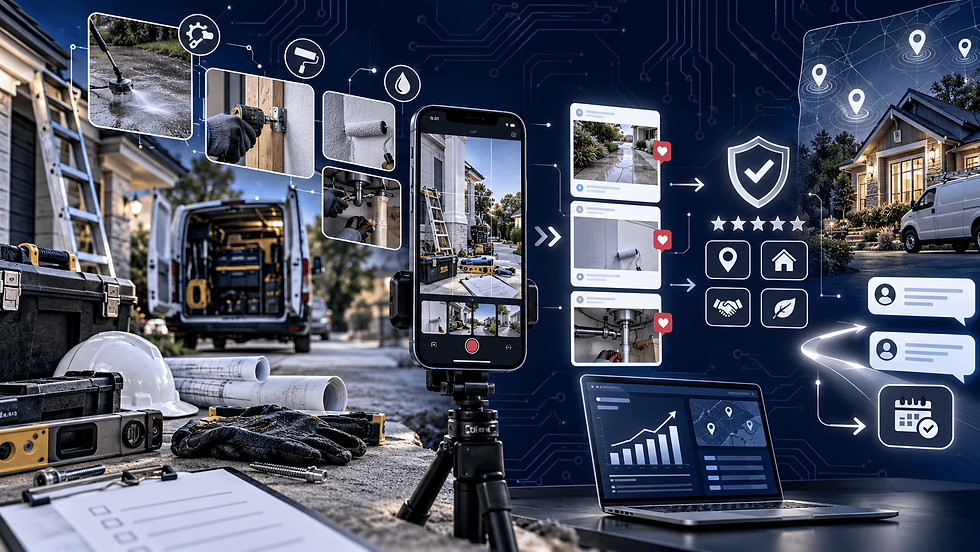
The barrier is never material — your business generates this content every working day. It's capture habit: the phone comes out for sixty seconds at the start, middle, and end of jobs, and the monthly batch session turns the camera roll into the calendar. No production values required; the light shake of a real phone in a real hand is the aesthetic. Captions in your own voice, one honest sentence about what's happening and why it matters.
One boundary: get comfortable consent for anything showing customers' homes or faces, and keep addresses out of frame. Trust content that violates trust defeats itself.
The Compounding Effect
Here's what a year of showing the work builds: a public record of competence that no competitor can counterfeit and no ad budget can shortcut. When the neighbor asks the Facebook group for recommendations and someone names you, the curious click through to — not a brochure — a working business, visibly good at its craft, run by recognizable humans. The recommendation confirms itself. That's the whole trust machine, and it runs on sixty-second clips of Tuesday.
That public record supports Reputation Management too: prospective customers aren't relying on one polished claim, but on months of visible proof that the business consistently does what it says.
Frequently Asked Questions About Behind-the-Scenes Content
What counts as behind-the-scenes content for a local business?
Anything customers don't normally see: the prep before the job, the process mid-work, the tools and materials, the shop in the morning, the team doing the actual doing. The everyday reality of your business is the content.
Why does behind-the-scenes content perform so well?
It reads as real in feeds full of polish, it satisfies genuine curiosity about how things get done, and it quietly answers the trust question every local customer is asking: what will these people actually be like on my property or in their shop?
What if my work is messy or unglamorous?
That's the appeal, not the obstacle. Customers already suspect the work is messy — showing it with competence and care is exactly what builds confidence. The businesses that only show perfection get less trust, not more.
Ready to Grow Your Business?
Trio Assist helps Minnesota and Wisconsin businesses turn clicks into customers.
About the Author

Brandon G. Wallin Owner & Founder, Trio Assist
Brandon G. Wallin is the Owner and Founder of Trio Assist, a marketing agency based in Minnesota serving Stillwater, the St. Croix Valley, the Twin Cities, and businesses across the United States. He helps service-based companies build structured, high-performing marketing systems rooted in technical SEO, authority building, and long-term strategy.
Brandon believes growth isn't about chasing algorithms — it's about installing the right foundation. His work focuses on helping businesses rank where it matters, convert more consistently, and scale with clarity instead of guesswork.
When he's not building digital ecosystems, Brandon stays closely connected to the local business community throughout Minnesota and Western Wisconsin.


