
Building an Email List From Zero: Practical Ways Local Businesses Collect Addresses

Updated: Sep 8

There's a moment that stings for a lot of business owners: the day they realize their social media following isn't really theirs. A platform tweaks what it shows people, and suddenly posts that reached a thousand people reach eighty. The businesses that shrug at moments like that all have the same thing — an email list. The ones that panic don't.
We've written about what email marketing returns for small businesses. This post is about the step before that: building the list when you're starting from zero, which is where most local businesses in Minnesota and Wisconsin honestly are.
Building an Email List From Zero: Start With the Reason Someone Would Join
Nobody subscribes out of charity. "Sign up for our newsletter" is an ask with no answer to the customer's silent question: what's in it for me? So before collecting a single address, decide what being on your list gets someone. It doesn't have to be elaborate — it has to be true.
For a service business: first access to schedule openings, seasonal reminders that save customers money, a genuinely useful guide. For a shop or restaurant: new arrivals, events, subscriber-first offers. For a coach, creator, or practitioner: one good idea a month in their inbox. Pick the honest version for your business and say it plainly wherever you ask: "Join the list — one email a month, what's new, and first crack at openings."
Put the Ask Everywhere a Customer Already Is
List building fails less from weak offers than from invisible ones. The ask should live at every point of contact you already have. On your website — not just a buried footer form, but a clear sign-up on your most-visited pages. At the counter or on the invoice, with a QR code that opens the form. In your email signature. On receipts and thank-you messages. Pinned on your social profiles, which is also the smart hedge: converting borrowed followers into owned subscribers.
The physical touchpoints matter more for local businesses than the internet gives them credit for. The customer standing in your shop or shaking your hand at the end of a job is warmer than any website visitor will ever be. A simple spoken "want me to add you to the list? One email a month" converts astonishingly well — same principle as the review ask: warm moment, small request, easy follow-through.
Make Joining Frictionless
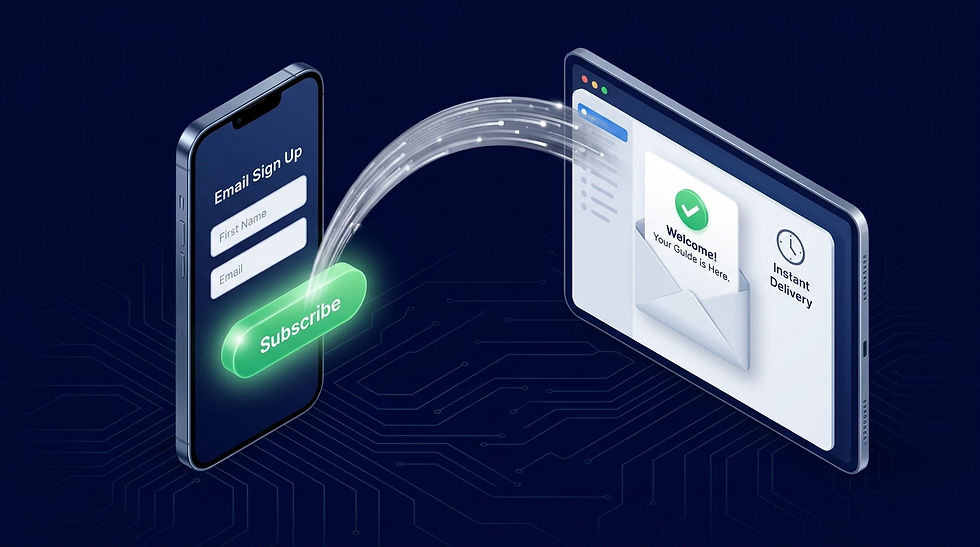
Every field you add to a sign-up form costs you subscribers. Ask for the email address, maybe a first name, and nothing else. The form should work perfectly on a phone. And confirmation should be instant — ideally a welcome email that delivers whatever was promised, arriving while the person still remembers signing up. That welcome message is the highest-open email you will ever send, which is why it should be automated from day one — the exact pattern we covered in email sequences and automation. A web design that places the sign-up form prominently on high-traffic pages — not buried in a footer — is what turns website visitors into list subscribers consistently.
Grow at The Speed of Trust, Not Tricks
A few things not to do, learned from cleaning up after them. Don't add customers to your list just because you have their email from an invoice — consent is both the law's requirement and the list's quality filter. Don't buy lists; purchased addresses don't know you, don't open, and teach inbox providers to route you to spam. And don't over-promise frequency you won't keep — a list that hears from you monthly, reliably, stays warm; a list that hears nothing for six months has quietly expired.
A small, consented, local list beats a big cold one at everything that matters: opens, replies, bookings, and the compounding familiarity that makes people choose you without shopping around. This is exactly why digital marketing built around owned channels — not rented ones — creates stability that social media alone never will.
The List Is Patient Money
Here's the long-game truth: every address you collect this year is a customer you can reach for free, on your terms, for years. Slow months, new services, a second location, a weather event that fills your schedule — the list is how you activate demand without buying it each time. Few assets in local business compound as quietly or as reliably.
Frequently Asked Questions
Why does a local business need an email list when it has social media followers?
Because you own the list. Social platforms decide who sees your posts and can change the rules overnight; an email lands in the inbox of everyone who gave you their address. The list is the only audience a business truly controls.
What should a local business offer to get email sign-ups?
Something genuinely useful to your customers: a practical guide, a seasonal checklist, early access to openings or specials, or simply a good monthly email people want. The offer matters less than making it honest and the sign-up easy.
How big does my list need to be before it's worth emailing?
Start emailing at any size — even fifty local subscribers is fifty warm customers hearing from you monthly. Small local lists tend to be far more engaged than big anonymous ones, and the habit of sending is what grows the list.
Ready to Grow Your Business?
Trio Assist helps Minnesota and Wisconsin businesses turn clicks into customers.
📍 Trio Assist, LLC | Lake Elmo, MN | info@trioassist.com | 651-705-6391
About the Author

Brandon G. Wallin Owner & Founder, Trio Assist
Brandon G. Wallin is the Owner and Founder of Trio Assist, a marketing agency based in Minnesota serving Stillwater, the St. Croix Valley, the Twin Cities, and businesses across the United States. He helps service-based companies build structured, high-performing marketing systems rooted in technical SEO, authority building, and long-term strategy.
Brandon believes growth isn't about chasing algorithms — it's about installing the right foundation. His work focuses on helping businesses rank where it matters, convert more consistently, and scale with clarity instead of guesswork.
When he's not building digital ecosystems, Brandon stays closely connected to the local business community throughout Minnesota and Western Wisconsin.
